On the Cost of Forgetting
Great Grandpa Henry seeing German dead on the walls of St. Peter's — With the 47th Medical Battalion, 1st Armored Division — Oran to Tunis — Treating German soldiers — Evil in practice — The Italian Campaign — Raining fire on Anzio — The fall of Rome — Something about cataclysms
To get to Rome, the 1st Armored Division had to cross the Alban Hills outside the city. Your great grandpa wrote in his journal that the roadside was littered with German dead. At least three days old, he wrote. Dark burgundy and full of maggots, he wrote. That's what he wrote. Just matter of fact like that. Dark burgundy and full of maggots. And when he got there, he visited all the tourist sites just like a regular tourist. He wrote that St. Peter's was beautiful, but when he looked up at the walls, he saw the dead on the walls like a mural. All of those dead soldiers he had seen, all up on the walls. He wrote that it seemed like he had ridden to Rome over a mass of bodies. He wrote that it took over a hundred years to build St. Peter's, but none of us could construct a human body. That's what he wrote. He wrote that Rome was the site of a lot of wasted bodies. He would know, wouldn't he. He would know.
The thing is, kids, I think we've forgotten. I think that's a big part of the problem. Your great grandpa saw firsthand what can happen when these forces run wild. It was not an abstraction, kids. He was haunted by visions of bodies full of maggots, kids.
You see, it's a problem. These charlatans today, always running their mouths. Like there's no cost for what they're doing. Steeped in ignorance and aggression, they talk and talk and talk. There is no end to their talking and there is no avoiding it. They talk about internal enemies, kids. They say they pose a bigger threat to the Republic than any foreign enemy. They compare them to rats and bugs that need to be eliminated. Do you know what that means? That means that they believe, or at least they say that they believe, that certain of their fellow American citizens need to be neutralized. Political adversaries. Journalists. Government workers. Teachers.
How are they supposed to be neutralized? Well, there's a lot of loose talk about treason and jail and capital punishment. That means you're killed by the state for the crime that you have committed. Steeped in ignorance and aggression. Some of them are truly stupid. Others know exactly what they're doing. And those are the ones who are the real problem, kids. People say it can't happen here, kids. No no no. Not here. Well, it is happening here, kids. It is currently happening. We are all witnesses to it, even if we can't or don't want to admit it.
Your great grandpa, kids. He was in the 47th Medical Battalion, 1st Armored Division. They had these trucks with a tent that you'd pull out of the back to create a little mobile emergency room. He was close to the front. Injured soldiers would come to him, and if he could easily fix them, he'd send them back into battle. If not, he'd send them to the rear for more care. He was a factory doctor. A Frigidaire plant in Dayton. He was used to industrial accidents, the type of stuff you see when people get tangled up in machinery. That's why they put him in the 47th close to the front. He was used to handling mangled arms, hands, legs. But he had never seen anything like what he saw there, kids, no, nothing like it at all, the type of damage that weapons do to the human body.
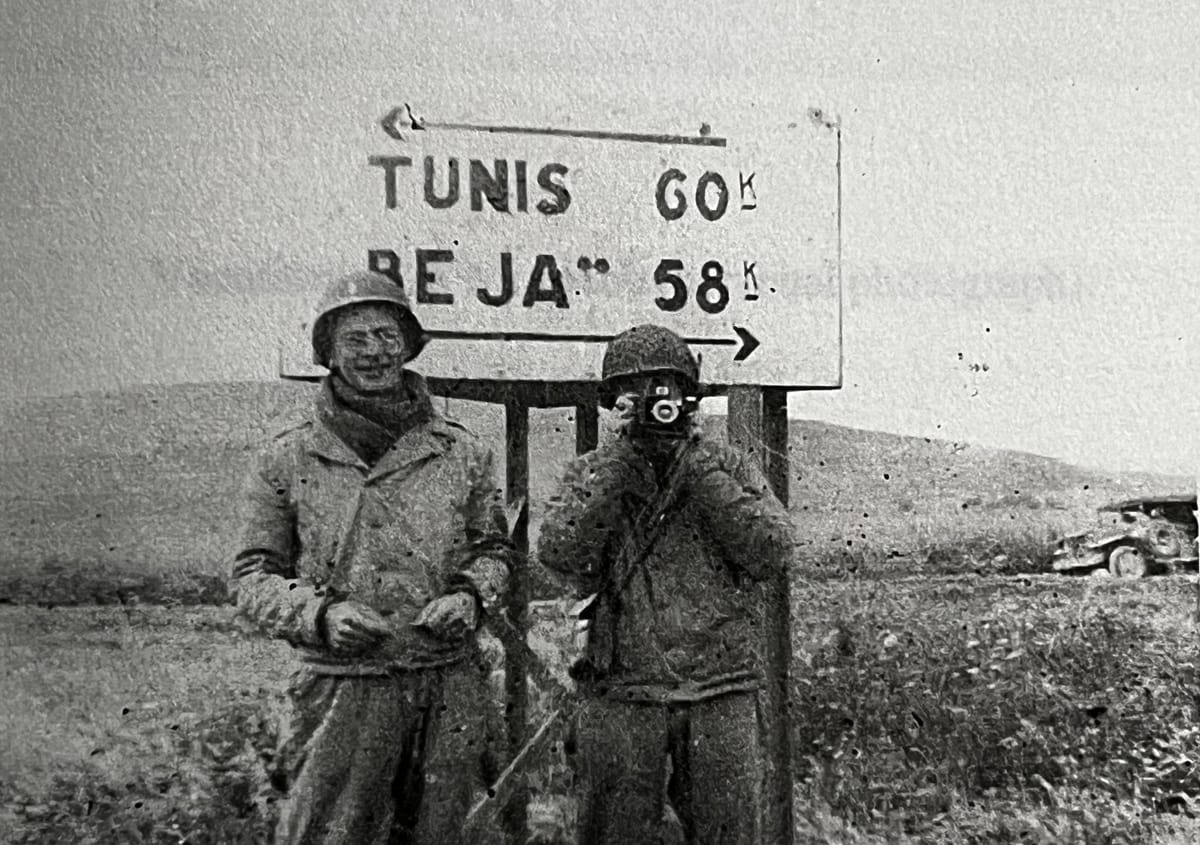
They landed in Oran. That's in Algeria, kids, and the goal was to drive east and take the port cities of Bizerte and Tunis in Tunisia. These journals of his, they are amazing. Look here, you can trace where they went, the battles along the way, places we'll probably never see: Maknassy, El Guettar, Gafsa, Mateur, Sbeitla, Kasserine Pass. Look, there are photos of him, this one in front of a road sign: Beja, 58 kilometers to the right, Tunis, 60 kilometers to the left. There's a photo of his truck with the tent set up in the back. That's where he did his work, kids. Right there in the middle of the desert. He worked on American soldiers right there.
And you know who else he worked on? German soldiers. That's right. As the push to Tunis intensified, he saw more and more injured Germans who had been captured in battle. He took care of them. He heard them tell stories of the invincible American war machine bearing down on them. He thought they were cocky but got along with them OK. It was not an abstraction, kids. He worked on these young men who had been pressed into service by a fascist regime. How many of them believed in what they were doing? How many of them were fascists themselves? How many of them had bought into the fool's quest of reclaiming some lost version of German history that never existed?
These are not academic questions, kids. They were there trying to kill your great grandpa. Debates about intentionality and motivations of people are at some point beside the point. Evil in practice, kids. It does exist. He saw it. He saw what happened when these forces run free. We can see it too. It's all right here in this box of his if we're willing to see it.
After Africa, the 1st Armored Division headed to Italy. The American and British commanders couldn't really agree on a strategy, kids, and it was kind of a mess. The British wanted more of a full-court press to take Rome, but the Americans didn't want to divert too many resources from their coming invasion of northern France. I'm no war historian, kids, but the Allies' Italian campaign seemed to lack the strategic vision of their more successful campaigns elsewhere.
So what happened to the 1st Armored Division and 47th Medical Battalion? They ended up at Anzio. That's right here, kids. Just to the south of Rome. You see it? Now, here's the thing. They got stuck there. For months — for months — they were stuck right there. It was known as the Anzio Beachhead during the war, and they could not move off of that beach. The thing with Italy is, there are mountains everywhere. It's an easy place to defend. And the Germans were dug in. The Italians had surrendered already. These were German positions and they rained fire on the beachhead.
Look, there are photos of him. Yes, these are in color. They did have color photos then. There he is. He's smiling in this one somehow. And that's his medical tent in the background. See the red cross on top? They weren’t supposed to get shelled and bombed. But rear was forward and forward was rear and they were all crammed onto that beachhead. Everybody was a target.
They worked while shells rained down. They learned to judge the distance of a shell's landing and kept working through it. They figured they wouldn't hear the one that hit them, so they wouldn't worry about it. I don't know if I believe that, kids, but that's what he wrote.
The bombs were another matter. The night bombings. Anti-personnel bombs. The swishing whirl of the bombs. He could hear them and he thought that this must be the one. This must be the one that's going to finally land on me.
For months. Anxiety. Exhaustion. Battle fatigue. That's what they called it then. He wrote to your great grandma that he didn't have it, but he must have. How could he not have had it?
They shelled and bombed the soldiers. They shelled and bombed the doctors. They were pinned down. They were sitting targets. The injured men were delivered to your great grandpa’s tent. A lot of them died. A lot of them were broken forever.
Do you hear what I'm trying to tell you? I don’t know what I'm trying to tell you.
He thought he was going to die.
He wrote letters to your great grandma. She didn't know, and he couldn't tell her. She was trying to survive on her own with two little ones. He wrote to her and couldn't say much. He wrote to her and couldn't say I'm trapped here on this beach and I'm seeing these young men torn apart and I'm scared I'm going to die. The shells and the bombs never stop and I'm scared I'm never going to see you and the boys again.
Do you hear what I'm trying to tell you because I don't know what I'm trying to tell you but I'm trying and I need you listen.
When they finally broke through, they had to cross the Alban Hills outside of Rome. And that's where he saw those German soldiers dark burgundy and full of maggots. Those German soldiers. He had treated them in his tent. What did they believe in? What were they thinking when they were trying to kill him? What were they afraid to lose when they died by the road in the hills outside of Rome? When your great grandpa saw them they were full of maggots and when he got to Rome and visited St. Peter's he saw them up on the wall all those bodies up on the wall.
Do you understand that? I don't either. I don't. And the thing is, it didn't end in Rome. They kept chasing the Germans north and there are mountains there too. And it was slow and getting cold. Late in 1944. They were chasing the Germans from ridge to ridge and the echoes of the shells were close and all around all the time. And he was highly sensitized. That's what he wrote. I am highly sensitized and I don't know what I'm going to do. He was struggling with all of the echoes and wanted to go home. The views were magnificent but we've all had enough of that. That's what he wrote. We've all had enough of that.
What am I trying to tell you? That when things get out of control, they can really get out of control? Yes, but what else? That mass delusion is possible, yes. At the societal level, yes. That everything seems controllable until the moment that it no longer is, yes. That these forces are hard to control, yes. Once they've been set loose in the system, it is difficult to bring them to heel.
But what else? That they can be brought to heel. We did it before, and that's why your great grandpa was stuck on a beach in Italy. That's what it took before. And I guess the question that I have — and I do not have an answer for you — is whether they can be brought to heel without that kind of cataclysm.
What's a cataclysm? A very violent event or series of events or something similar to that is probably close to the dictionary definition. There are some words that seem to really match what you're trying to describe. Cataclysm is one of those words. That's what your great grandpa experienced. That's what World War II was.
So we know we can bring the forces to heel that way. But can we otherwise? That's what I don't know, kids. I don't think we're doing a good job currently. I’m confident in that. We built a system to avoid having to do this again, and we are now dismantling that system. Purposefully, yes. There are crooks and vandals purposefully dismantling it and they know exactly what they're doing. But also passively, kids. That's where I fit in. All of the people like me. Passive participants in the dismantling of the system. What would you have me do? Stand up and say I will not be a willing participant in this? That I will do everything in my power to resist these forces that seek to turn us against one another in the service of an authoritarian minority that betrays every last one of our founding principles?
That's asking a lot, kids. I don't know. It could be this is just the natural order of things. That we are bound to forget and that this has all been one long process of forgetting since he came home. He returned to Dayton. He went back to the Frigidaire plant. The war derailed his career. He had wanted to be an orthopedic surgeon, but was already older when he was drafted, and when he got out he figured it was too late. So he went back to the plant and stayed there. Untreated rheumatic fever that he had probably caught in Italy wrecked his joints. He didn't want to talk about the war. He seemed like he wanted to forget about it.
I guess we keep moving forward because that's what we have to do. That sun comes up and it's time to make the coffee. I guess we are bound to forget. Ask any random person about Anzio and you will get a blank stare. Ask them about the Germans dug in in the mountains around Rome and they won't know. What was that all about, anyway?
Your great grandpa died in 1973. Before I was born. I never met him, but I feel like I know him. I don't know what he'd think of me or us or what we're doing here. He may think I'm full of it for trying to divine some deep meaning out of the stuff in this box. It was what it was and is what it is and he came home and that was that. Maybe this is all fine and were fine. Maybe if we keep telling ourselves that, it will continue to be so. Maybe we can hold this thing together with duct tape and Gorilla Glue for a while longer. It feels like it's all falling apart, but maybe. Just maybe.