Ranking Ohio's Vice Presidents
Although it feels like it's been twelve years, we are just about one year into the Trump-Vance calamity catastrophe disaster apocalypse tragedy comedy farce administration. And you know what that means: It's time for a fresh ranking of Ohio's vice presidents.
Known as the "Mother of Obscure Presidential Trivia Presidents" due to it being the birthplace of seven presidents and primary home of an eighth (William Henry Harrison, whose thirty-two days in office guaranteed that posterity would remember that his presidency lasted for at least a full month), Ohio also claims four vice presidents, including, of course, the current occupant of our government's most inconsequential office.
For the purposes of this ranking, we're going in ascending order from best to worst, meaning that the worst will be ranked No. 1, which only seems appropriate given Ohio's electoral track record of late. So, without further ado, we present the 2025 Year-End Re-Ranking of Ohio's Vice Presidents.
4. Charles Dawes. Born in Marietta, Ohio, Dawes served as vice president under President Calvin Coolidge from 1925 to 1929. Dawes graduated from Marietta College in 1884 and Cincinnati Law School in 1886, and embarked on a business career that included owning a share of gas plants in Wisconsin and Illinois. His early political career included a stint as the U.S. Comptroller of the Currency under President McKinley and a failed U.S. Senate bid from Illinois in 1902.
He was a general in World War I, and after the war, chaired the group that devised what became known as the Dawes Plan, pursuant to which U.S. banks loaned money to Germany to help its economy recover and to make reparations payments to France and Belgium as required by the Versailles Treaty. We all know how that turned out. But at the time, the plan must have seemed like a good idea, because Dawes was awarded the Nobel Prize for his work on it.
At the 1924 Republican National Convention at which Coolidge was nominated for the presidency, Dawes was the third pick for the vice presidency after the first two guys declined the nomination. But the third time's a charm, as the kids say, even for the vice presidency, and the Coolidge-Dawes ticket easily won the election that fall.
There's not much to say about his time as vice president. This was the jazz era, after all, and government was mostly in the business of being in business and preparing to run the country into the ditch of the Great Depression, etc. Coolidge and Dawes apparently didn't get along. Coolidge even vetoed a farm bill Dawes personally invested himself in passing through Congress, which is quite a thing.
Also worth noting: Dawes was a self-taught musician, whose composition "Melody in A Major" became popular and was later re-arranged multiple times, including in 1951, when Carl Sigman added lyrics to it and renamed it "It's All in the Game". In 1958, Tommy Edwards's version of the song turned it into a No. 1 Billboard hit, which leads to the ultimate bit of Wikipedia trivia: Dawes and Bob Dylan are the only people credited with both a No. 1 pop hit and a Nobel Prize.
Anyway, there's a not inconsequential chance that Dawes did something (or things) that made him a terrible human and not worthy of being the least bad on this list, but I'm a working attorney, not an historian. There's only so much time I'm willing to devote to researching vice presidents. So, at No. 4 (and least bad) he'll stay.
3. Charles Fairbanks. Born in Unionville Center, Ohio, Fairbanks served as vice president under President Theodore Roosevelt from 1905 to 1909. After graduating from Ohio Wesleyan University in 1872, and then studying the law in Pittsburgh and Cleveland and being admitted to the Ohio bar in 1874, Fairbanks moved to Indiana, where he became a railroad financier and served as counsel to the scumbag robber baron Jay Gould. Unsurprisingly, seeing as he was serving as counsel to a scumbag robber baron, Fairbanks became active in Republican politics and was apparently good at it, gaining enough prominence to be the keynote speaker at the 1896 Republican National Convention.
In 1897, he was elected to the U.S. Senate, where he served with little distinction for eight years. There isn't much to say about his vice presidency, either. He was caricatured as a Wall Street puppet, and President Roosevelt considered him a reactionary machine politician. To which, I think you’ve got to ask old Teddy: Then why did you pick him to be your vice president?!? That must be what Roosevelt himself wondered, as he gave Fairbanks little to do in his administration. And Fairbanks, meanwhile, spent his time as vice president actively working against the progressive "Square Deal" policies of his boss. Quite a pair, these two.
The most interesting thing you can say about the guy is that he was the first vice president to serve a complete term without casting any tie-breaking votes as president of the Senate. Also, Fairbanks, Alaska is named after him. Way to go, buddy. When Roosevelt decided not to run for re-election, he supported William Howard Taft over Fairbanks as his successor, and that was pretty much the end of Fairbanks's political career, although he did keep trying to return to national office after that.
All in all, according to my completely arbitrary and unscientific evaluation metrics, Fairbanks seems worse than Dawes, but less bad than the other two jokers on this list.
1 (tie). Thomas Hendricks. I know some of you will be deeply disappointed and alarmed that our favorite fake-Appalachian-but-real-Christofascist JD Vance isn't No. 1 on this list, but we here at Acorn Drive follow where the facts lead us, and I've got to say, the facts led us to an interesting place with one Thomas Hendricks.
Born in Muskingum County, Ohio, Hendricks served as vice president under President Grover Cleveland for a mere eight months in 1885. His parents moved to Indiana when he was a baby, and he built his career in that state, graduating from Hanover College in 1841 and being admitted to the Indiana bar in 1843. He was a lawyer in private practice when he wasn't running for office, but he ran for office quite a lot, including for governor three times, which he finally won in 1872. He also served stints in the Indiana House of Representatives, U.S. House of Representatives and U.S. Senate.
It was his time as a senator that vaulted him to the top (which, remember, is a bad thing) of this prestigious list. A lifelong Democrat, Hendricks served in the Senate from 1863 to 1869, a momentous stretch involving the end of the Civil War and beginning of Reconstruction. He did support the Union and the war effort, so kudos to Hendricks on that front. But as for Reconstruction . . . hoo boy.
Hendricks voted against the Thirteenth, Fourteenth and Fifteenth Amendments to the U.S. Constitution, which abolished slavery and established civil rights for the formerly enslaved. He claimed that the timing wasn't right to make major changes to the Constitution. Sure thing, boss. More likely, it was his raging, unapologetic racism that swung his vote, rather than some supposedly sincerely held political beliefs. I mean, check out this humdinger Hendricks quote from a congressional debate in 1869:
I am speaking of a race whose history for two thousand years has shown that it cannot elevate itself. I am speaking of a race which in its own country is now enshrouded by the darkness of heathenism, the darkest heathenism that covers land on earth. While the white man for two thousand years past has been going upward and onward, the negro race wherever found dependent upon himself has been going downward or standing still. . . . What has this race ever produced? What invention has it ever produced of advantage to the world? . . . This race has not been carried down into barbarism by slavery. The influence of slavery upon this race – I will not say it is the influence of slavery – but the influence of the contact of this race with the white race has been to give it all the elevation it possesses, and independent and outside of that influence it has not become elevated anywhere in its whole history. Can you tell me of any useful invention by the race, one single invention of greater importance to the world than the club with which the warrior beats to death his neighbor? Not one.
Well, okay then. Hendricks is another example of how racial politics have completely flip-flopped since the Civil War era. Can there be any doubt that Hendricks would be a Republican today? That is a rhetorical question.
Anyway, although he was in ill health, he was Cleveland's running mate in 1884, and served as vice president from his inauguration on March 4, 1885, until he died on November 25 of that year. His reported last words were "Free at last", which is honestly pretty rich coming from a guy who voted against the Reconstruction Amendments.
Given his voting record and abominable racism, Hendricks has secured a tie for worst on this list. JD will likely eventually outdo him, but at least for now, Vance hasn't done anything to move himself above (below) a guy on the record in the most notorious way possible for resisting constitutional rights for former slaves.
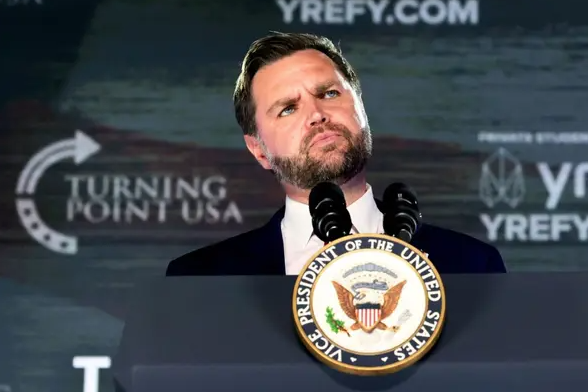
1 (tie). JD Vance. And so we arrive at JD. Oh, JD. Born in Middletown, Ohio, he is, of course, our current vice president. And what a rascally little scamp he is. He's a fake Appalachian. A fake Catholic. He's changed his name about a dozen times. He called Trump America's Hitler before magically transforming into his biggest cheerleader. The dude is as authentic as a three-dollar bill.
He's buddies with the worst of the techbros, including noted vampire weirdo venture capitalist Peter Thiel. He has declared Western Europe our enemy. He's participated in the saber-rattling about stealing Greenland from Denmark. He's apparently resentful that his wife, who is Hindu, hasn't converted to his fake Catholicism. He traffics in dangerous, racist lies, like the one about Haitians in Springfield, Ohio eating household pets. He doesn't like immigrants, Ukraine or childless people. He has declared universities our enemy (together with Western Europe, I guess??), which I'm assuming includes where he attended, Ohio State and Yale. He is a spreader of the Big Lie that the 2020 election was stolen and has said that he would not have certified the results if he had been vice president. Lately, he has really leaned into the Christian nationalist thing. Here's an excerpt from his recent speech at the Turning Point USA Young Nazi Hoedown AmericaFest:
Part of the American dream is the idea that we’re all, every single one of us, on the same team, we’re all part of the same American family. If you want to destroy that, do what Democrats have done, not just for the last five years, but for the last 30 or 40. Make one race the enemy of another. Make one gender the enemy of the other. Make Americans suspect and despise each other instead of loving their shared country.
When I think about some of the most impassioned debates happening in our country, the nature of citizenship, of what it means to be an American, it all speaks to an obvious truth. Americans are hungry for identity. We’re hungry for belonging. We’re hungry for a sense of our place in the world, and it’s no surprise why.
For many years, our fellow Americans have been dealing with a globalized economy that homogenized cultures and hollowed out our towns. Academics and activists pushing race and gender politics down everyone’s throat 24-7. Big tech overlords using their internet platforms to censor stories that challenge the dominant far-left narrative in our country.
More than any time, I can recount, people are talking about American identity and figuring out what it is that unites us. But I want to say something here. The only thing that has truly served as an anchor of the United States of America is that we have been, and by the grace of God, we always will be, a Christian nation.
That's some industrial-grade Christian nationalism right there. This was the same speech in which he equated Minneapolis with Mogadishu and said that, thanks to the Trump administration, you don't have to apologize for being white anymore. Can there be any doubt which side JD would have been on in the debate about the Reconstruction Amendments? That is a rhetorical question.
We're only a year into Trump II, and I am very confident that over the next three years, JD will do enough to take sole control of the top (worst) spot on this list. He is still a young man, politically speaking, and his ambition knows no bounds. It's the one thing about him that is authentic, and it's scary as hell.
Happy New Year, everyone!