Somehow the Solution to Journalism's Problems Is Always Fewer Journalists

Chris Quinn, Editor of Cleveland.com/The Plain Dealer, wrote a column (subscription required) last week about the use of AI in his newsroom that genuinely surprised me, although, honestly, shame on me for continuing to be surprised by this stuff.
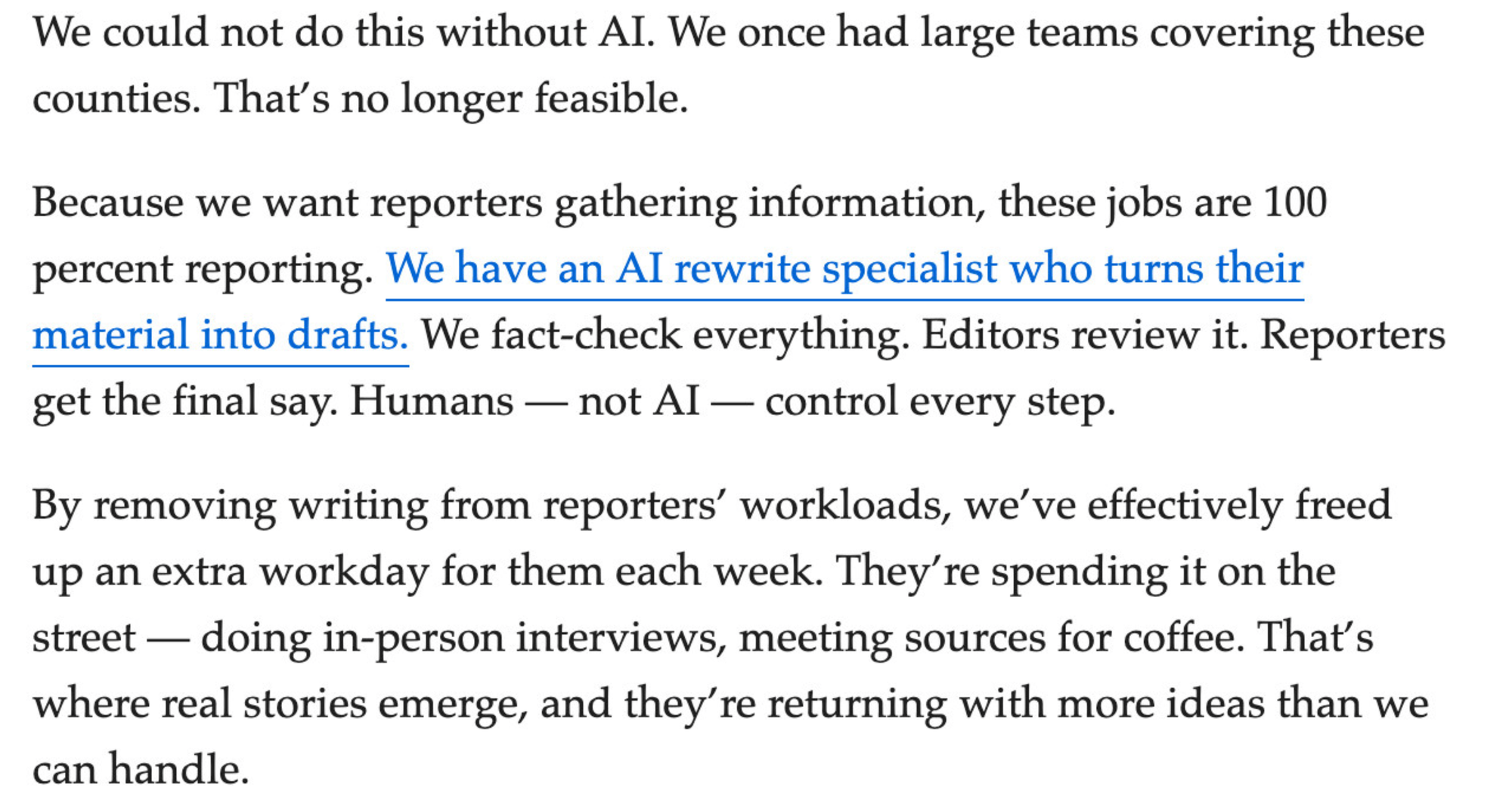
The upshot of the column is that The Plain Dealer is transitioning to a model under which reporters will no longer write but rather focus solely on reporting, i.e., talking to people, gathering facts, etc. How will the writing get done? By feeding the reportage into AI and letting AI do the work.
Quinn's theory goes that with writing removed from their responsibilities, reporters will be able to cover more ground gathering the news. From Quinn's column:
There's plenty of chatter about the column online if you care to find it. My point here is to focus on The One Eternal Rule of Legacy Media Innovations, which is this: whatever the latest innovation is, it always involves the employment of fewer journalists.
It's been 20 years since I left journalism for the law. My last job was at The Plain Dealer. I reported and wrote because that’s what the job required and what I'd been trained to do. I don't think I was particularly good at it and I may have ended up wandering into a different profession regardless. But I could see what was coming: the Internet about to eat the newspaper industry's lunch and then the newspaper industry itself.
That's not to call myself a prophet. It's not like this was occurring in secret. Anyone could see it. I chose not to stake my career on management figuring it out somehow. I wanted job security and health care and the realistic prospect of retiring at some point prior to death. There was a time when a job at a big metro daily promised those things. That time ended right around the time I got into the business.
It may be that Quinn is correct, that AI is the solution for depleted newsrooms. I don't agree with that proposition in any way, but I also can't pretend to have answers to the declining circulation and ad revenues that have bedeviled the industry for a quarter century. What I am confident of is that Quinn would have a more sympathetic audience for his AI gambit if it didn't follow years of other gambits that degraded the product he's selling.
Management's responses to tough times have tended decisively in one direction: shrinkage. Shrink the number of sections. Shrink the physical size of the paper. And above all else, shrink the editorial staff. It's management premised on cutting your way to profitability rather than investing in making your product into something people want to buy.
I don't know the answer. I do know that regions like Northeast Ohio would be better off with media capable of holding power to account and that the old way of accomplishing that seems busted for good.
In the meantime, I'm focusing most of my journalism spending on independent subscription-based outlets (such as Talking Points Memo) and nonprofits (such as ProPublica and Ohio Capital Journal) that seem focused on investing in their news operations rather than chasing the latest gimmick.